

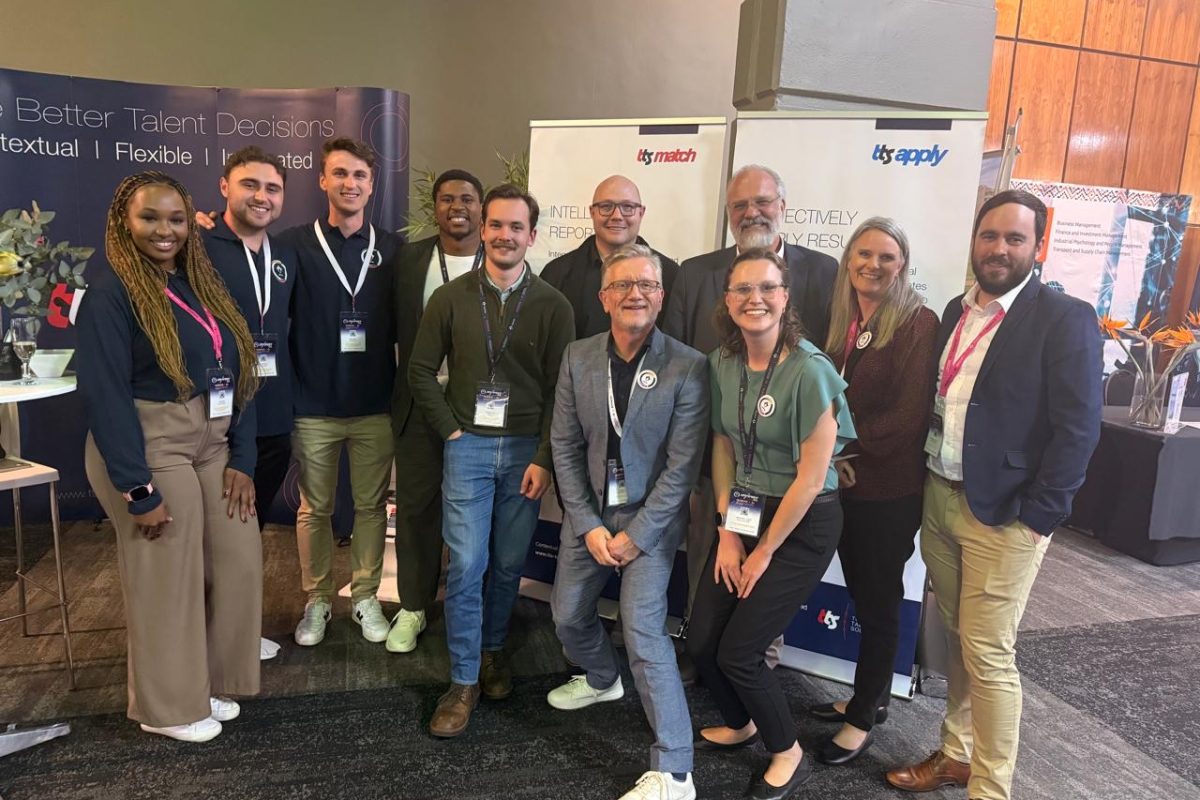
The 2026 SIOPSA Conference brought the profession together under the theme Human + AI: Designing Positive Organisations through Augmented Intelligence, Inclusion, and Well-being.
Across 11 sessions, TTS contributed to conversations about AI-enabled employee insight, leadership development, technology adoption, assessment integrity and the future role of Industrial and Organisational Psychologists. While the sessions approached these issues from different perspectives, a central message emerged: AI can enhance professional practice, but its value depends on the evidence, judgement and accountability surrounding its use.
Using insight to support organisational change
In Listening Without Asking, Telkom’s Sam Cammarata joined TTS’s Busisiwe Mahlobo and Eltroné Wilhelm to demonstrate how AI can supplement traditional employee-listening approaches. The case study showed how more than 161,000 external data points were used to identify employee experience strengths, potential barriers and practical organisational priorities.
The role of evidence in development was also explored in From Insight to Impact, presented by Manuella Manolas and Rachael Watkins. Their case study demonstrated how assessment, aspirations, feedback and coaching can be integrated to support individual leadership growth while also informing broader talent and organisational priorities.
Fred Guest’s session, Why Some Employees Embrace Technology and Others Don’t, shifted the focus to technology adoption. The case challenged organisations to look beyond simple labels such as adopter or resistor and consider whether employees are willing, able and allowed to engage with technology. It highlighted the importance of tailoring learning and change strategies to different employee needs.
Rethinking assessment in the GenAI era
Assessment practice featured prominently in TTS’s conference contributions.
In his master tutorial, Gen-AI and the Future of Assessment, Prof Hennie Kriek shared insights from global assessment leaders on three possible responses to GenAI: mitigating its risks, using it to augment existing practices and strategically embracing its potential.
This was complemented by the research presentation GenAI in People Assessment, delivered by Dr Sebastian Clifton and Dr Angela Marsburg. Their research examined the vulnerability of different assessment formats, emerging score patterns and the potential value of honesty agreements and technology-based safeguards. The findings suggested that GenAI risk should be actively managed, but not sensationalised.
Prof Kriek also contributed to the panel AI in Assessments: Building Awareness, Ensuring Best Practice, and Promoting Ethical Development and Use, while Fred Guest participated in the closing keynote panel on The Integration of Generative AI into Pre-employment Assessments.
Together, these sessions reinforced that no single safeguard will protect assessment integrity. Responsible practice requires appropriate assessment design, clear candidate communication, proportionate controls, ongoing monitoring and professional oversight.
Examining the promises and responsibilities of AI
Prof Kriek also joined the keynote panel Unfulfilled Promises of AI in Industrial and Organisational Psychology, which considered what AI has genuinely delivered and where expectations continue to exceed reality.
Dr Danie Oosthuizen extended this reflection in Have We Become AI-ologists? His master tutorial challenged IO Psychologists to distinguish between the outputs they produce and the professional responsibilities they carry.
AI can generate reports, summaries and recommendations. It cannot hold professional registration, understand every aspect of an organisational context or accept accountability when a decision causes harm. The distinctive contribution of the IO Psychologist therefore remains rooted in contextual interpretation, evidence stewardship, ethical judgement and professional responsibility.
Preparing the profession for what comes next
The future of the profession also featured in sessions on advanced research and the development of emerging IO Psychologists. Busisiwe Mahlobo contributed to a panel on pursuing a PhD in Industrial Psychology, while Natasha de Ravel de l’Argentière explored the skills future practitioners will need across the professional lifecycle.
Together, these discussions highlighted the importance of developing practitioners who can use AI confidently while retaining the research capability, critical thinking and professional judgement required for responsible practice.
Final reflection
The conference did not present AI as either a threat to resist or a solution to accept without question.
Instead, the TTS contributions demonstrated the need for a more deliberate partnership between technology and human expertise. AI can help organisations listen, assess, develop and make sense of information at greater scale. However, its contribution will ultimately depend on the quality of the science, ethics and professional judgement guiding its use.
To learn more about any of these topics or presentations, please contact us at info@tts-talent.com.