
The HR profession is undergoing a significant transformation. Artificial intelligence, increasingly sophisticated people analytics and changing organizational expectations are challenging established assumptions about what HR professionals do and what makes them effective. While technological competence is becoming increasingly important, the emerging picture is more complex than simply adding AI skills to an existing job description.
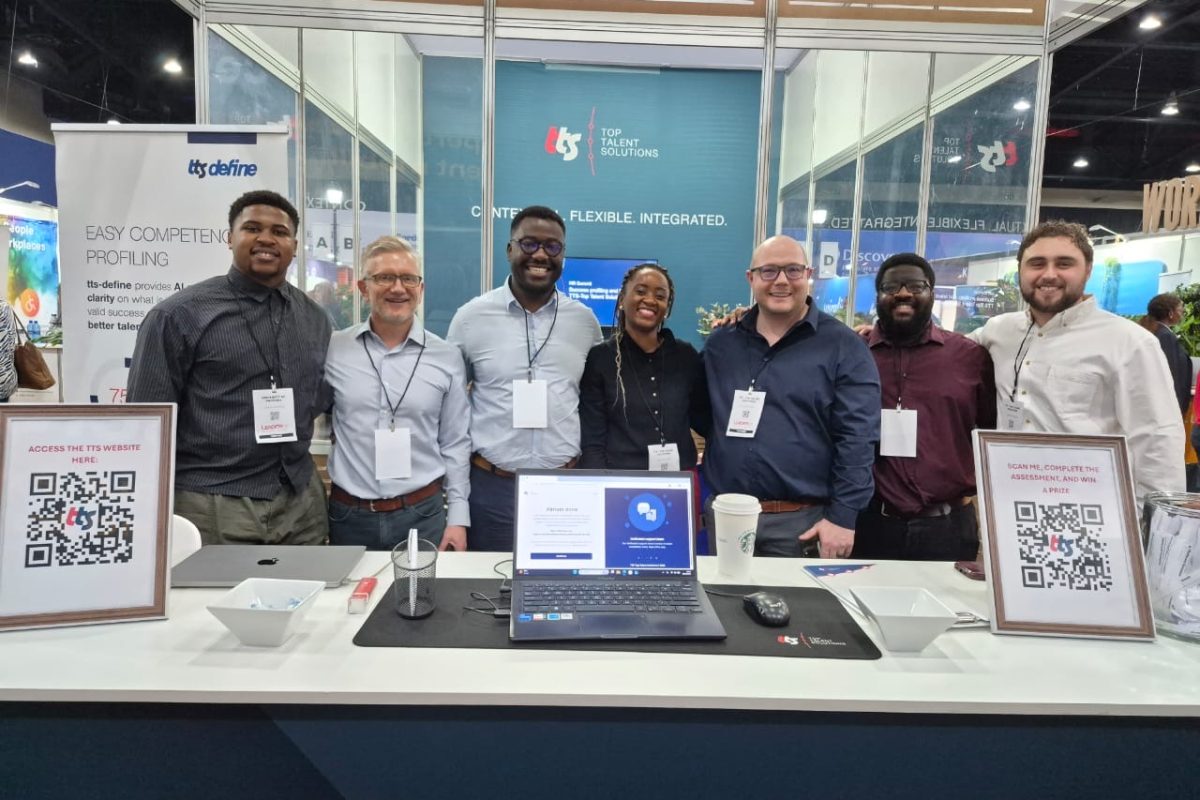
At the recent 2026 HR Summit in Sandton, TTS-Top Talent Solutions invited HR professionals to consider the question:
- What does the ideal HR professional of the future look like?
Through a combination of live competency profiling, AI-generated analysis, psychometric assessment demonstrations and professional discussion, attendees explored the behavioral characteristics that might distinguish effective HR practitioners in the years ahead.
HR as a profession in transition
Current research has identified four forces that are reshaping the HR function.
- The growing automation of transactional work. As AI assumes more routine administrative and information-processing tasks, HR professionals are increasingly expected to contribute to strategic workforce decisions rather than simply manage established processes. Drawing on Gartner’s 2026 HR priorities, reconsidering the HR operating model may be among the most consequential applications of AI for HR leaders.
- The increasing importance of analytical thinking. The World Economic Forum’s Future of Jobs Report 2025 identifies analytical thinking as a core capability for employers, with approximately seven in ten organisations identifying it as particularly important. The report also anticipates substantial changes in workplace skills by 2030. For HR professionals, this implies the ability to interpret evidence, evaluate competing explanations, understand uncertainty and translate information into defensible decisions about people.
- HR is increasingly expected to lead responsible AI adoption. Our summit presentation drew on AIHR’s 2026 HR trends to highlight a gap between the growing expectation of AI fluency and practitioners’ reported preparedness. HR professionals are becoming important participants in decisions about algorithmic fairness, employee privacy, governance and the appropriate boundaries of automation.
- Human judgment is central. Finally, as AI systems become increasingly capable of generating recommendations and performing complex tasks, the premium placed on human judgement may increase rather than diminish. Professionals must be able to interrogate AI outputs, recognise their limitations and exercise judgement where competing organisational, ethical and human considerations arise.
Together, these developments suggest a changing professional identity for HR practitioners.
HR professionals will have to evolve from transactional administrators to strategic contributors, from policy enforcers to AI governance and ethics stewards, and from generalists to data-fluent decision partners.
The challenge is translating these broad expectations into specific, observable competencies that can inform selection, development and succession planning.
An exercise in defining the future HR professional
To explore this question, TTS invited summit attendees to participate in a live competency-profiling exercise using Aon’s ADEPT-15 behavioural framework.
Participants were presented with 15 behavioral characteristics from the ADEPT-15 and asked to identify the five they considered most important for the HR professional of the future. In parallel, TTS used our internally-developed AI profiler to develop a competency profile for the same role. Drawing on selected 2025/26 future-of-work research, the system applied the structured ranking approach used in TTS’s tts-define success-profiling application.
The AI-assisted process evaluated the 15 competencies through seven profiling iterations and organised them into three categories: seven essential competencies, seven important competencies and one considered less important.
The exercise therefore brought together two distinct sources of judgement. The participating HR professionals contributed their experience of organisational demands and effective HR practice. The AI profiler generated a structured interpretation of the future role based on the information and research supplied to it.
| TTS AI-assisted profile | Summit delegates profile |
| 1. Flexibility | 1. Flexibility |
| 2. Awareness | 2. Drive |
| 3. Conceptual | 3. Awareness |
| 4. Cooperativeness | 4. Assertiveness |
| 5. Composure | 5. Structure |
Two ADEPT-15 behavioral characteristics emerged across both perspectives: flexibility and awareness.
Their prominence may well point to the context of a rapidly changing HR profession.
Flexibility concerns the capacity to adjust behaviour and approaches as circumstances change. For HR professionals, this might involve adapting workforce practices to new technologies, responding to changing business requirements or reconsidering established procedures when they no longer serve their intended purpose.
Awareness, particularly openness to feedback, indicates an important self-reflective dimension. Professionals who recognise limitations in their own knowledge, seek relevant information and remain receptive to alternative interpretations may be better positioned to navigate unfamiliar challenges.
From an IO Psychology perspective, these characteristics are especially interesting because they connect with broader constructs such as adaptability, learning orientation and self-regulation.
The differences between the two profiles were also revealing.
Summit participants placed relatively greater emphasis on drive, assertiveness and structure. These characteristics speak to the practical realities of HR work: maintaining momentum, influencing stakeholders, managing competing priorities and ensuring that decisions are implemented.
The AI-generated profile, by contrast, assigned greater priority to conceptual thinking, cooperativeness and composure.
One interpretation of the differences is that practitioners may have been drawing on the immediate demands of their roles. HR professionals frequently need to deliver results under pressure, influence managers and introduce structure into complex organisational situations. From this perspective, drive and assertiveness are understandable priorities.
The AI profile may have placed greater emphasis on capabilities associated with navigating complexity, collaborating across functions and maintaining sound judgement under uncertainty.
The distinction between current and future requirements is also important. Are practitioners identifying what makes HR professionals effective today, while the AI-generated profile emphasises what might become important tomorrow? Or are the two perspectives simply highlighting different, complementary aspects of effectiveness?
These questions illustrate why competency profiling benefits from structured discussion rather than relying on a single source of judgement.
Effective performance in future HR roles
For IO P sychologists, perhaps the most important lesson concerns the relationship between competency models and job performance.
A competency framework is only useful to the extent that it captures characteristics relevant to the actual requirements of a role.
Broad descriptors such as flexibility, conceptual thinking and assertiveness may sound desirable, but their meaning depends on the occupational context.
For example, assertiveness may be particularly important when an HR business partner must challenge senior managers about questionable employment practices. Cooperativeness may be essential when coordinating multidisciplinary initiatives. Composure may become critical during restructuring, conflict resolution or organizational crises.
Similarly, conceptual thinking is valuable when it helps professionals recognize patterns, evaluate organizational problems and formulate effective interventions. Its importance cannot simply be assumed because the role is becoming more strategic.
The appropriate starting point is therefore a systematic analysis of the work itself.
What decisions must HR professionals make? Which outcomes are they expected to influence? What knowledge, skills and behavioral characteristics support those outcomes? And how are these requirements likely to change?
This is particularly relevant when developing profiles for emerging roles, where historical job-performance data may be limited or less representative of future demands.
A defensible approach would combine evidence from job analysis, subject-matter experts, organizational strategy and relevant occupational research.
The role of AI
The comparison also offered a practical demonstration of how AI might contribute to competency modelling.
AI systems can help synthesize information, generate alternative descriptions of role requirements and highlight characteristics that stakeholders may not initially have considered. Used appropriately, they may improve the efficiency and breadth of early-stage role analysis.
However, an AI-generated competency profile should not be confused with independently established evidence of what predicts success.
The quality of its recommendations depends on the information supplied, the assumptions embedded in its instructions and the processes used to evaluate its output.
Agreement between AI and human judgement is not, in itself, validation. Equally, disagreement does not establish that one perspective is more accurate.
This distinction matters because AI-generated recommendations can acquire an appearance of objectivity simply through their numerical presentation or apparent consistency.
For IOP practitioners, responsible use requires transparency about how profiles are developed, critical review by suitably knowledgeable professionals and appropriate validation before profiles are used to support consequential employment decisions.
The summit’s AI comparison was valuable precisely because it created opportunities for questioning rather than replacing professional judgement.
Willing, able and allowed: An organizational context of AI readiness
Another important element of the summit presentation was its human-centred approach to AI readiness.
The TTS model distinguishes between three conditions influencing responsible AI adoption: whether employees are willing, able and allowed to use AI effectively.
Willingness encompasses motivation, openness, trust and professional identity. Ability concerns the knowledge, behavioral skills, ethical understanding and practical competence needed to apply AI appropriately. Being allowed refers to the organizational conditions that support or constrain its use, including leadership, culture, policies and access to suitable tools.
This distinction has important implications for how organizations conceptualise future HR capability.
An HR professional may be highly motivated to use AI but lack the necessary skills. Another may possess considerable technical competence but work in an environment where expectations are unclear or appropriate safeguards are absent.
Consequently, successful adoption cannot be explained solely through individual attitudes or capabilities.
This is consistent with a longstanding principle in organizational psychology: performance is influenced by the interaction between individual characteristics and the opportunities, resources and constraints provided by the work environment.
It also suggests that organizations should avoid treating AI readiness exclusively as a selection or training problem.
Developing future-ready HR functions may require simultaneous attention to individual capability, managerial support, organizational culture and governance.
Final thoughts
The summit highlighted a broader challenge for organizations preparing their HR functions for the future.
Rather than beginning with a list of competencies or technological capabilities, organizations should first examine how the HR function itself is changing.
This includes identifying activities likely to be automated, responsibilities that will require greater analytical or strategic involvement, and situations where human judgement and interpersonal capability remain indispensable.
From there, HR leaders and IO Psychologists can develop provisional success profiles, identify suitable assessment and development approaches, and evaluate whether the resulting competencies are meaningfully associated with performance.
Importantly, future readiness should not be reduced to recruiting a new generation of supposedly ideal professionals. Many of the capabilities identified at the summit, including learning orientation, analytical reasoning, adaptability and effective collaboration, can also be supported through professional development, work design and organizational learning.
The HR profile of the future appears to demand an integration of capabilities that have sometimes been treated separately: analytical thinking and interpersonal understanding, adaptability and sound judgement, strategic influence and ethical responsibility, technological fluency and sensitivity to organizational context.
For IO Psychologists, this is familiar territory. As the HR profession evolves, its contribution will depend not merely on adopting new technologies, but on applying psychological science to understand changing work requirements, evaluate emerging capabilities and make better decisions about people.
If you would like to know more about how future trends may be shaping the HR industry, drop us a line at info@tts-talent.com.